Republican Candidate · November 2026
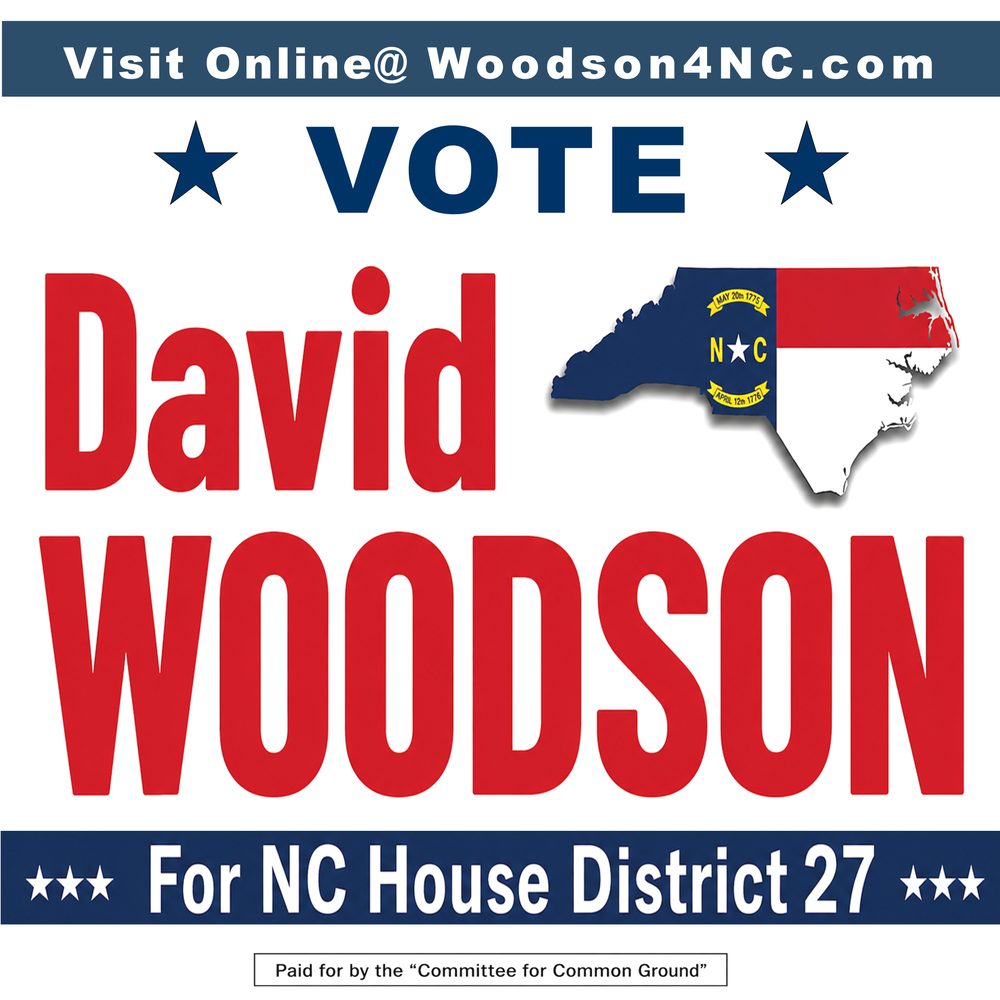
For NC House District 27
Warren · Halifax · Northampton
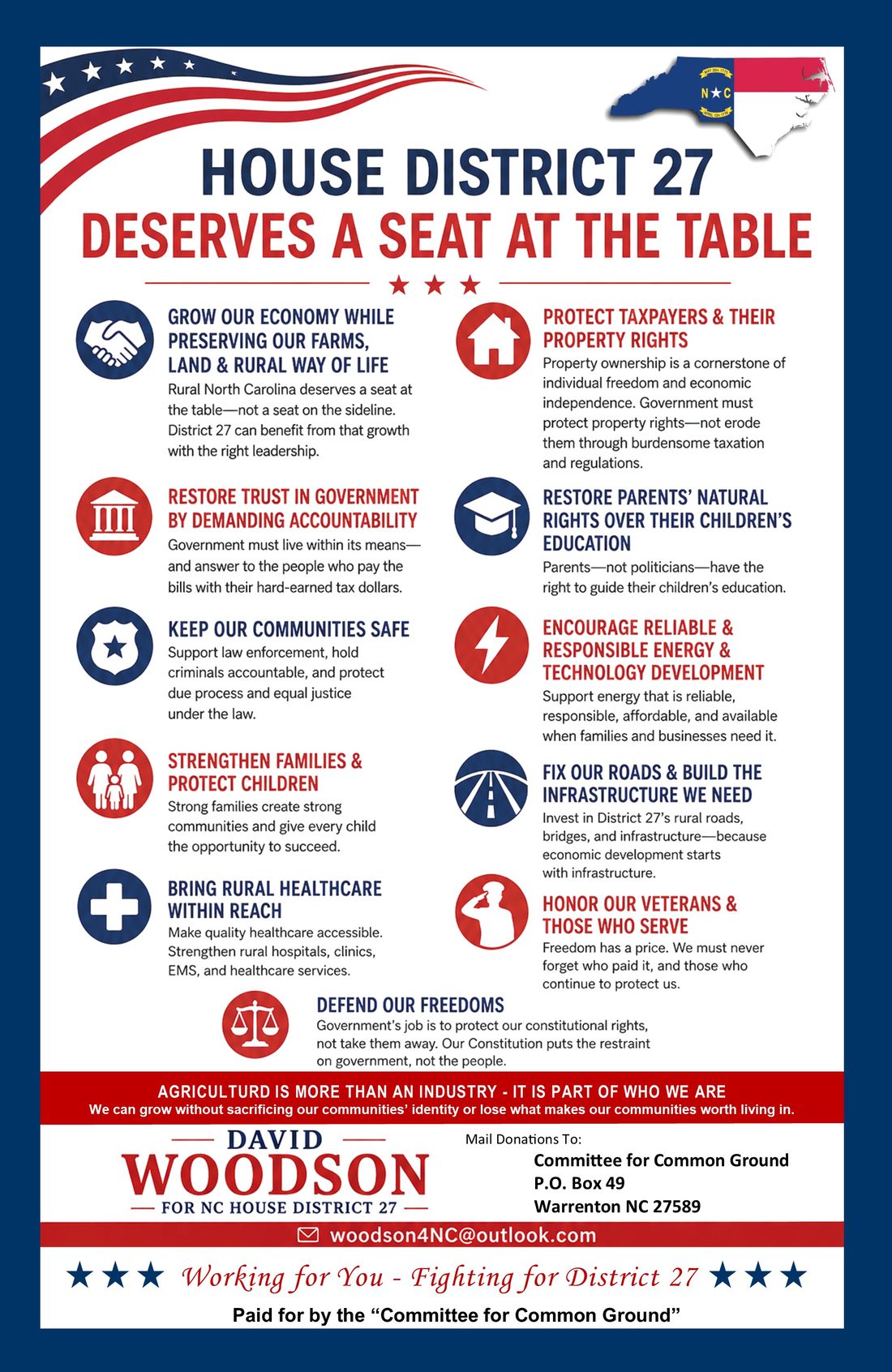
Rural North Carolina deserves a seat at the table.
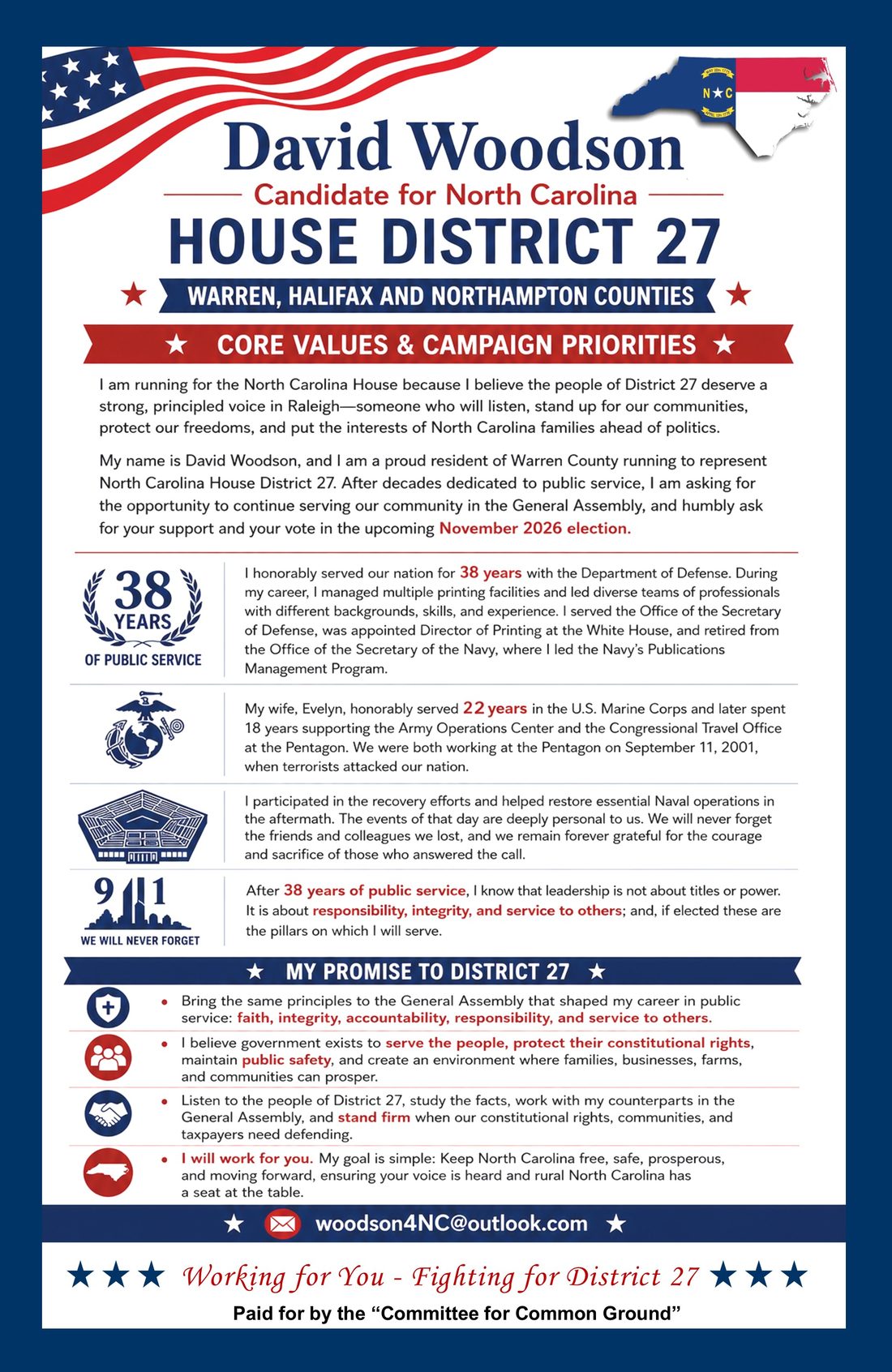
38 years of public service. Working for you — fighting for District 27.
Meet David
I'm David Woodson — a Warren County resident, a husband and father, and a candidate for the North Carolina House.
For 38 years I served our country with the Department of Defense. I managed printing facilities and led teams of professionals from every background. I served the Office of the Secretary of Defense, was appointed Director of Printing at the White House, and retired from the Office of the Secretary of the Navy, where I led the Navy's Publications Management Program. Along the way I managed people, programs, contracts, budgets, and resources, solving problems when they arose, and ensuring objectives were met and the mission was accomplished.
My wife Evelyn served 20 years in the U.S. Marine Corps and spent 18 more supporting the Army Operations Center and the Congressional Travel Office. We were both at the Pentagon on September 11, 2001. I took part in the recovery effort and helped restore essential Naval operations in the days that followed. We will never forget the friends and colleagues we lost.
I learned there that identifying a problem is only the first step. Leadership means removing barriers, finding solutions, and following through.
I'm running because District 27 deserves a strong, principled voice in Raleigh — someone who will listen, stand up for our communities, protect our freedoms, and put North Carolina families ahead of politics.
After 38 years of service, I know leadership isn't about titles or power. It's about responsibility, integrity, and service to others.
My Priorities
Here is what I intend to change in Raleigh. Open any priority to read where I stand in full.
Water, sewer, broadband, roads, and power are the backbone of every business and every household. They should be reliable and affordable everywhere in District 27 — not just where the population is dense.
Our county and municipal leaders are more than capable of delivering, if Raleigh gives them the resources, incentives, and support to do it. My job would be to remove the barriers in their way. I'll work with our commissioners, municipalities, NCDOT, and fellow legislators to identify priority projects and push hard for funding until those needs are met — including helping rural communities secure state and federal infrastructure dollars so the burden doesn't fall entirely on local ratepayers.
I also want to cut the regulatory drag that makes it harder for families to improve older homes and harder for small businesses to grow here. Not health and safety protections — the layers that add cost and delay without protecting anyone. A corporation can afford a compliance department. A homeowner or a small-business owner can't.
We have land, hardworking people, agriculture, and the I-95 and I-85 corridors. What we don't have is a strong enough voice competing for investment. I intend to be that voice.
I'll work directly with each county's Board of Commissioners to identify and pursue the projects that matter most locally. We need good-paying jobs and business sites that fit a rural district — not development for its own sake, and not a district that becomes the state's dumping ground.
That means the right infrastructure in the right places, while protecting property rights, agricultural land, and the character of our communities. The goal is simple: bring investment to District 27 without sacrificing who we are.
Agriculture is more than an industry — it is part of who we are. The best way to preserve farmland is to make farming pay.
Families shouldn't feel forced to sell their land or accept development that doesn't fit. Keeping farming viable means giving landowners flexibility to use their property productively, improving rural infrastructure, and connecting farmers to new markets.
There's real opportunity in diversification: livestock, specialty crops, orchards, nurseries, and vineyards. Value-added processing, packaging, and canning so farmers capture more of what they grow. Farm stands, farm-to-table, agritourism, harvest festivals, livestock shows, and legal hunting and fishing that bring visitors and dollars into the district. Timber and forestry management for long-term income. Better farm roads, irrigation, drainage, storage, and broadband — productivity gains that don't require another acre.
When you're 30 or 40 minutes from a major medical center, response time is everything. We shouldn't have to leave rural North Carolina to find quality care.
Low population density makes it hard to sustain rural hospitals, clinics, and practices. We need to recruit doctors and nurses to rural communities, expand telehealth where it makes sense, support our rural hospitals and emergency services, and cut the barriers driving up costs.
EMS and volunteer rescue organizations are healthcare too. They need modern equipment, ongoing training, adequate staffing, and reliable funding. In a rural county, the first few minutes decide the outcome — and this is an area where we can add good-paying jobs.
Many of our residents already travel to ECU Health facilities for care. Positioned along I-95 and I-85, we have a real opportunity to build on that existing network and bring quality care closer to home. As your representative, I'll work to encourage and support the partnerships that make that happen.
Parents — not politicians — have the right to guide their children's education. Our first responsibility is student achievement.
Teachers should be paid as the professionals they are, and we should be honest about whether students are actually learning. Schools must equip children with strong reading, writing, and math, critical thinking and problem-solving, an understanding of our shared history, and the foundation to become responsible, independent, productive citizens.
Education is a partnership — administrators, parents, teachers, and students — and everyone has to do their part. If we keep governing schools the same way, we shouldn't expect different results.
I want to explore a Parent Governance Board with defined statutory authority alongside the elected school board. Not a duplicate of it — a second body with concurrent authority over a defined set of decisions:
| Elected school board | Parent governance board |
|---|---|
| Budget and resources | Curriculum transparency |
| Facilities | Instructional materials |
| Personnel | Parental rights |
| Administration and operations | Student conduct |
| Long-term strategic planning | Educational choices |
| Parent concerns and appeals |
Made up primarily of parents with currently enrolled students, independently selected rather than appointed, holding public meetings and issuing written recommendations. It isn't about power. It's about parents having a real seat at the table — and taking on real responsibility for preparing students for college, careers, the trades, entrepreneurship, or military service.
Taxes are a necessary obligation. So is proving the money was spent well. Where's the transparency? Where are the results?
Tier 1 funding brings state resources into our district, and sales taxes and other state funds feed local revenue. Our property taxes have gone up. Taxpayers should be able to see where the money comes from, where it goes, and what we're getting back. We should measure government by what it accomplishes — not by how much it spends.
I'll fight to make sure District 27 gets its fair share of state funding while insisting every dollar is treated as a responsibility, not an entitlement. Tax policy should encourage people to invest, start businesses, create jobs, and stay in North Carolina. Government should set the conditions for growth — not try to control the outcome. Growth should happen with a community, not to it.
On property rights: if you lawfully own a farm, a home, a business, or a piece of land, you should have a real voice in what happens to it. Property rights aren't only about land — they're about liberty, economic opportunity, and the limits of government power. Secure property rights are what give people the confidence to invest, build, and create jobs. I'll defend the rights of law-abiding property owners.
Firm on crime. Consistent in enforcement. The rule of law applies equally to everyone.
Public safety starts with supporting law enforcement and giving our communities the officers and resources to stay safe — recruiting and retaining qualified officers, making sure our courts function, and holding people who commit crimes accountable.
We shouldn't confuse compassion with a lack of accountability. People who commit crimes should answer for it, and those struggling with addiction or mental illness should have access to treatment that breaks the cycle of repeat offenses. Immigration is a public safety and rule-of-law issue: enforce the law, cooperate with federal authorities, hold criminals accountable regardless of status, and respect due process.
At the same time, overcriminalization is a real problem — one that falls hardest on lower-income citizens, small property owners, churches, and community organizations. I'd support a formal process to regularly review North Carolina's criminal laws and repeal offenses that are obsolete, redundant, or unnecessary, and to downgrade some offenses to civil or regulatory violations where criminal penalties don't fit the conduct. I'd also support limits on agencies and local governments creating new criminal penalties by rule without clear legislative authority. Tough on real crime, careful about inventing new crimes.
I support helping women and families facing difficult pregnancies. Pregnancy-care centers provide real services, and those services serve a legitimate public purpose.
These centers offer medical and prenatal referrals, ultrasounds, pregnancy support, parenting education, diapers, transportation, food, housing assistance, and material help — much of it free. Many continue that assistance after the child is born.
My goal is to give women practical alternatives and real resources, particularly when financial hardship might otherwise make continuing a pregnancy extremely difficult. That is a reasonable argument for allowing these organizations to compete for public funding.
If North Carolina is serious about reducing unintended pregnancies and helping families become economically stable, we should support organizations that provide tangible assistance to women facing difficult pregnancies. The state can reasonably determine that helping women who choose to carry their pregnancies to term serves a legitimate public purpose. It is about supporting families and their children.
Events
Come say hello. If you'd like David at your church, club, or community event, get in touch.
Nothing on the calendar right now. Check the campaign Facebook page for the latest, or invite David to your event at Woodson4NC@outlook.com.
The Record
Every vote below is a matter of public record. Bill numbers are listed so you can look them up yourself at ncleg.gov.
Two bills strengthening oversight of how state money is spent and how costly regulations get approved. Pierce voted against both veto overrides.
HB 549 — Expanded the State Auditor's authority to investigate potential misuse of state and federal funds, and set procedures for recovering debts resulting from fraud or misuse of public money. Stronger audit enforcement protects taxpayers from unrecovered losses. Voted against the veto override.
HB 402 — Increased legislative oversight of agency rules carrying significant projected costs, requiring legislative approval or higher voting thresholds above specified cost levels. It limits concentrated bureaucratic power and keeps expensive regulations from being imposed without legislative consent. Voted against the veto override.
Protection and self-defense are both a right and a responsibility. Security begins with the citizen, not the state.
HB 674 — Authorized lifetime concealed handgun permits, with changes affecting lapsed permits, storage arrangements and related liability protections. Voted against.
HB 193 — Combined firearm, school-safety, law-enforcement and criminal-penalty provisions. As enacted, it allowed authorized employees and volunteers at nonpublic schools to carry on school property; allowed concealed carry at certain schools located at places of worship during services; increased penalties for assaulting or threatening government officials; and required judicial determination of pretrial release conditions in those cases. Voted against, and against the override.
Cooperation with federal immigration enforcement, and public order on public property. Pierce voted against both.
HB 318 — Established procedures for immigration-status verification, immigration detainers, and transfer of certain individuals in state or local custody to federal authorities. Requiring cooperation and limiting release when a valid detainer is issued strengthens the rule of law. Voted against the veto override.
HB 781 — Restricted regular camping and sleeping on public property, with exceptions for specified health, safety and shelter-capacity conditions. Compassion for those in need has to be balanced with responsible governance. Voted against.
Three bills concerning parental authority, taxpayer funding of gender-transition procedures, and protections for parents raising children according to their biological sex.
HB 606 — Addressed the use of state funds for certain gender-transition procedures involving minors and prisoners, with related medical-liability provisions. Voted against.
HB 805 — Established statutory definitions concerning biological sex and addressed taxpayer funding of certain gender-transition procedures, parental rights, and birth certificates. It also allowed religious objections to classroom activities, required public access to school library catalogs, and restricted mixed-sex sleeping quarters on school trips. Voted against the veto override.
SB 442 — The Parents Protection Act. Parents could not be accused of abuse or neglect solely for raising a child according to the child's biological sex, giving them statutory protection against having their parenting characterized as abuse. Voted against.
Five votes on where public money goes — Medicaid contracts, guaranteed income, school scholarships, and DEI programming.
SB 378 — Directed the state to discontinue Medicaid provider contracts with Planned Parenthood and certain affiliated abortion providers, and to transition affected services to other Medicaid providers. Our tax dollars should not pay for abortions. Voted against.
HB 859 — Restricted cities and counties from establishing recurring guaranteed-income programs of unconditional cash payments, while preserving programs tied to work, training or reemployment. Generosity must be voluntary, not coerced, and handouts are no substitute for jobs. Voted against.
HB 87 — Authorized North Carolina to participate in a federal tax-credit program supporting donations to qualifying scholarship-granting organizations, allowing scholarships for elementary and secondary education expenses including home schooling. Voted against.
SB 227 — Barred public school units from compelling students or employees to affirm defined divisive concepts, such as that one race or sex is inherently superior to another, or that a person bears responsibility for actions committed in the past by other members of the same race or sex. Voted against.
HB 171 — Restricted state and local use of public funds for specified DEI programs, barred DEI considerations in hiring and contracting, prohibited required DEI training, and set civil penalties up to $10,000 per violation. Voted against.
When licensing laws, zoning restrictions and compliance burdens make it impossible for working people to start a business, government becomes the obstacle.
HB 926 — Made broad changes to state and local regulatory authority covering permitting, inspections, zoning, property rights and administrative requirements. Voted against.
SB 316 — Restricted state and local agencies from requiring or disclosing identifying information about nonprofit members, donors and volunteers, with specified exceptions, and established remedies for violations. It safeguards associational privacy and limits state intrusion into lawful civic participation. Voted against the veto override.
HB 618 — Would have authorized a statewide standing order allowing pharmacists to dispense ivermectin without a prescription, subject to the bill's requirements. Ivermectin is FDA-approved for parasitic conditions including intestinal and filarial infections, scabies, head lice, and inflammatory lesions of rosacea. Voted against.
Pierce voted for the final state budget, SB 257. But SB 257 contains no direct county-specific appropriations for Warren, Halifax or Northampton. It included local appropriations for Brunswick, Sampson and other counties — and nothing for ours. He sat on the House conference delegation negotiating that budget and offered no amendment to put District 27 into it.
He did separately introduce House Bill 530, "Funds/Halifax, Northampton, Warren Counties." It did not pass. Voting for a budget is one thing. Fighting to make sure District 27 gets its fair share is another.
His website describes roughly $6.06 million as verified funding secured for District 27 between 2023 and 2024, broken into rural infrastructure grants, school facility upgrades, and community development and healthcare. The official record does show District 27 received state funding. What it does not establish is that he personally secured it. State budget office records identify the recipient, amount, funding source, administering agency and applicable program — they do not attribute an award to an individual legislator.
Take the $3 million Halifax County SelectSite investment: $2.35 million through the SelectSite Readiness Program and $650,000 in NCDOT matching funds. The General Assembly created that program in 2023, and the Halifax site had already been designated a SelectSite before Pierce took office. He voted for HB 1012, which funded the program, but the public record does not establish he originated or secured the Halifax award. The $114,000 for Historic Halifax came through HB 125, which appropriated that amount annually across thirteen historic sites statewide — and he voted against HB 125.
Based on the records I have been able to verify, I have not found documentation establishing that Pierce personally secured any specific new funding that would not otherwise have been available through existing state programs, statewide appropriations, or competitive grant processes.
Voters deserve to know the difference between money that came to the district and money a legislator actually delivered.
Get Involved
Three counties, a lot of ground, and not much time. Here's how you can help.
Knock doors, make calls, work an event. Tell us what you're good at and we'll put you to work.
Sign up below →Print the contribution form, fill it out, and mail it in. Checks payable to Committee for Common Ground.
Get the form →Campaign literature
Tap either card to read it full size, or print the contribution form.
Tell us how you'd like to help, and we'll be in touch.